Linked-read terminology
Linked-read data is whole genome sequencing (WGS). What that means is that whether you use the linked-read information or not, the data will always be standard and viable WGS compatible with whatever you would use WGS for. It’s WGS, but with a little extra info that goes a long way. But, because linked-read data has an extra dimension (the molecular barcodes), there are some additional concepts we need to consider that don’t exist in regular WGS or long-read data.
molecules
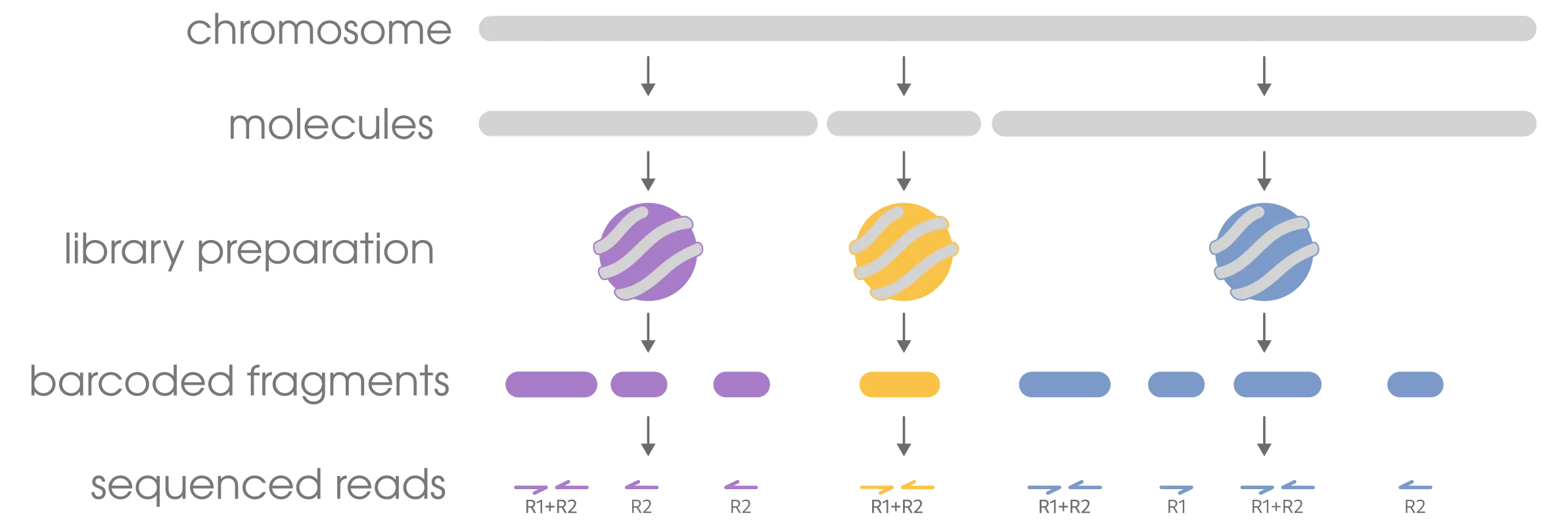
Section titled “molecules”In the linked-read context, the phrase molecule refers to a contiguous length of genomic DNA that went into library preparation. Extracted DNA is usually fragmented in some way, be it enzymes or liquid handling, so we cannot expect input DNA to be chromosome length.
inferred molecules
Section titled “inferred molecules”While molecules refer to the source DNA molecule, inferred molecules refer to the maximum extent of a molecule that we can infer from the sequencing data after alignment. If the original DNA molecule was 1Mb and our data included two fragments derived from it with the same barcode that were mapped 75kb apart, we can only infer the molecule to have been 75kb. Without mapping the reads, we cannot infer the sizes and positions of anything beyond the raw sequencing data.
fragments
Section titled “fragments”We typically think about sequencing data in terms of “reads” (e.g., a sequencer gives you 20 million reads for a sample), but you will notice the term fragment appearing in linked-read contexts, especially when using Harpy. The reason for this is because reads are an inaccurate metric for understanding the efficacy of linked-read data. Read 1 and read 2 of a read pair have the same barcode, so you could say that this barcode has 2 reads, and is thus linked. However, that would be incorrect, because read 1 and read 2 are opposite ends from the same DNA fragment and they don’t tell use anything about long-range information beyond what any standard paired-end read would. That is why we use the term fragment, which instead rightfully tells us how many DNA fragments sharing the same barcode are representative of a single molecule. The simple way to count these is:
| counts as 1 fragment | represented by |
|---|---|
| 1 read pair | R1 + R2 |
| 1 unpaired forward read | R1 only |
| 1 unpared reverse read | R2 only |
read clouds
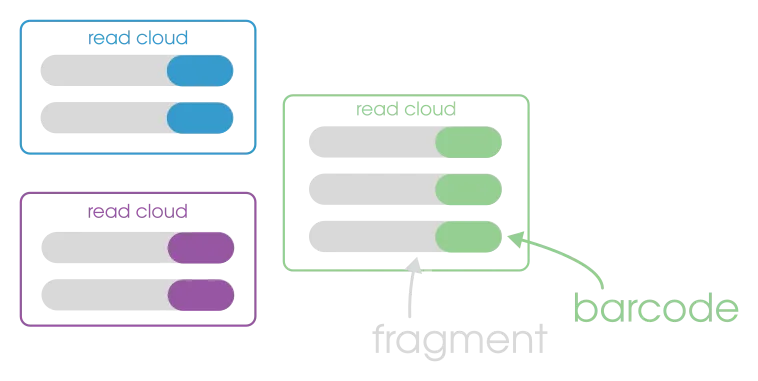
Section titled “read clouds”A read cloud is the collection of all of the sequences that have the same molecular barcode. This phrase appears often in earlier linked-read literature, but is less common now. Referring to something as a read cloud does not explicitly imply that the sequences have been deconvoluted (see below). We are unaware of any existing language that makes such a disctinction.
clashing / convolution
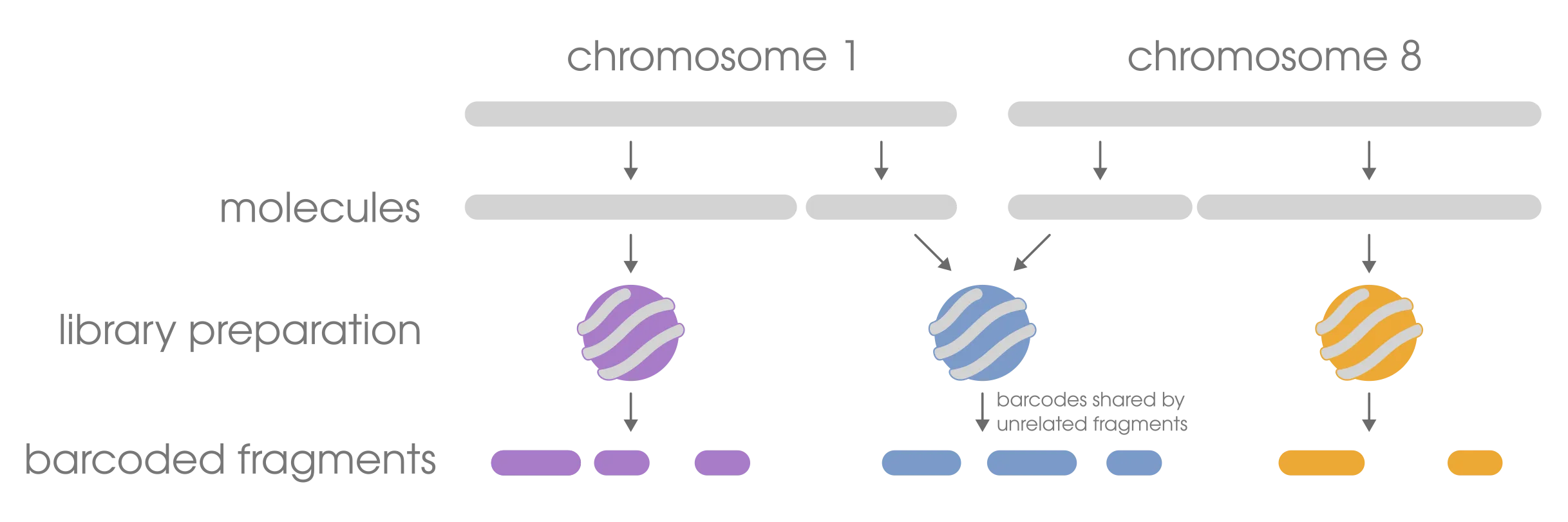
Section titled “clashing / convolution”By the nature of linked read technologies, there will (almost always) be more DNA fragments than unique barcodes for them. As a result, it’s common for barcodes to reappear in unrelated fragments. This is referred to as clashing or convolution and often needs to be dealt with so as to not incorrectly associate fragments with each other. The process of trying to correct convolution is referred to as deconvolution.
linked (vs singleton)
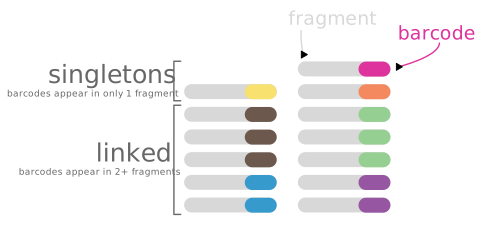
Section titled “linked (vs singleton)”Because linked reads need to be, well, linked, we need to know exactly how many of the fragments actually share barcodes. When a barcode is represented by two or more fragments, we call that linked, and the opposite is when a barcode only appears in one fragment, which is called a singleton. Since a singleton isn’t actually linked to any other fragment, the barcode information for that read (or read pair) is mostly useless, aka it’s just a plain-regular short read and can be used as such.