
BLink-seq Technical Specs
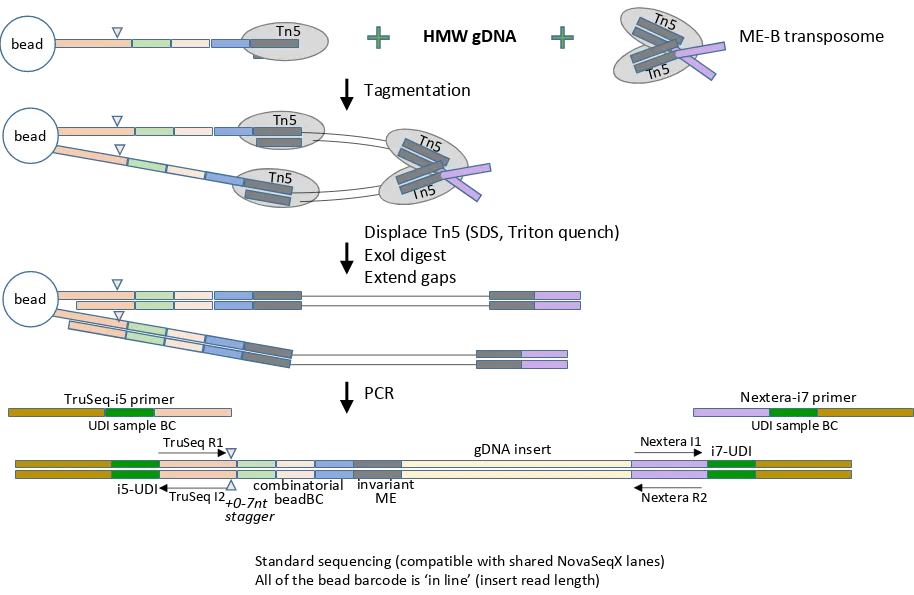
BLink-seq libraries are characterized by having a three 12bp segments and 1 variable-length “stagger” that comprise a combinatorial barcode. The segments each have a small spacer between them and the stagger serves to balance fluorescence during sequencing, along with acting as the 4th segment in the barcode. Each of the segments could be one of 96 unique barcodes, and the stagger can have a handful of length variants, resulting in ~7 million possible unique barcodes.
The libraries are also flanked with Universal Dual Index sequences, which serves 3 functions:
- provides a sample-level barcode in the index reads for demultiplexing
- mitigates barcode-hopping on NovaSeq machines
- makes them 100% compatible with standard sequencer runs, meaning no custom sequencer configurations or requests need to be made or known ahead of time
Data Characteristics
Section titled “Data Characteristics”Read Length
Section titled “Read Length”The barcode and ME sequence are part of Read 1 (as opposed to the index sequence), meaning after removing the technical sequences, Read 1 will be ~75bp. Since no analogous technical sequences are added to Read 2, it retains its full length (typically 150bp).
FASTQ format
Section titled “FASTQ format”BLink-seq traces its origins to haplotagging and uses the ACBD haplotagging barcode style so that
it can work seamlessly with existing linked-read software. BLink-seq data uses
the standard “LASTQ” format by default, meaning:
- the barcode is encoded in a
BX:ZSAM tag in the sequence header comment - it encodes read 1 and read 2 using the old CASAVA
/1and/2format, respectively- this is so aligners can safely transfer the BX:Z tag comment without crashing
- it uses a
VX:itag to indicate if a barcode is valid or notVX:i:0invalidVX:i:1valid